
Three Strange Wishes
By: Masood Ashraf
The idea of death and dying is a well-established concept that has captivated human minds for centuries. Civilizations across time attempted to understand or rationalize the concept. Among these groups were the ancient Hebrews, Egyptians and Chinese that all had various beliefs about death and dying. Throughout time, minds baffled at ways to find immortality and attempted ways to bring materialistic riches to the afterlife.
The ancient Egyptians in the BC era induced many bodies to become preserved in mummified states, thinking that the preservation of the body will ensure the safekeeping of the physical self and the soul for the world after.
Organs were safely stored in canopic jars to conserve the viscera in futile pursuits to refrain them from dying and losing their physical purpose. Intricate gold necklaces, embezzled gemmed stones and baroque items intended for kings and queens were placed next to coffins. Extraordinary and uniquely considerable measures were taken to create pathways between this world and the hereafter where the Egyptians could bring their life and their worldly possessions to the new life after.
Evidently all in vain, as death and dying is a concept that has been understood and believed to be inevitable, avoidable, and inflexible; much to the contradiction of what most ancient civilizations believed was possible. One of the most notable figures in history, Alexander the Great, was an iconic figure that historically is known for creating an incredibly large empire that stretched from Macedonia to Egypt and other places.
Not only did he manage to conquer thousands of cities of the ancient world, but he is also known for spreading scientific thought throughout his empire that ranged from science to mathematics. Many rulers from the ancient world often surrounded themselves with the highest and most valuable of items, and expected to be buried with ornate materialistic items to highlight their importance and divinity. Alexander the Great too earned much wealth, and like most leaders was expected to be buried with vast relics of his travels and journey to draw attention to his victorious achievements and greatness. However, in his final days, the great leader who ruled over the ancient world requested three wishes he asked to be fulfilled upon his demise.
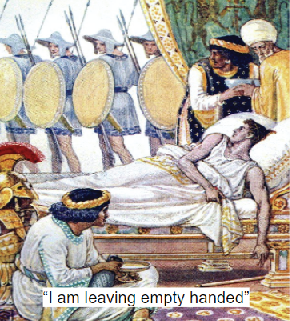
The wishes instructed to his generals were (1) That only his physicians carry his body (2) That the path leading to his grave be ornate with precious metals and gems and (3) that both his hands be open and kept dangling out of his coffin.
When the generals asked Alexander the Great about these strange requests, the ruler replied that (1) He wants to prove that by making physicians carry his dead body, that people understand no doctor can beat death. Death is an inevitable thing that will eventually have its way, and no physician of any sort can match this ultimate ending. (2) He desired that his pathway to his grave be ornate with treasures to show people that although he spent most of his lifetime chasing the riches of the world, he has to leave them all behind with the Earth and (3) He would like both his hands open and out of the coffin to explain that he will be leaving this world empty-handed, just as he was born.
In essence it is important to understand that the main idea of these requests from this great conquistador was that although he had achieved an incredible amount of success on Earth, he was subject to a mortal life and his achievements would do him no good in the life after death.
Evidently it is the nature of humans to be greedy and uncontended with material possessions. The Holy Prophet (saw) is reported to have said “Anas bin Malik reported: The Messenger of Allah, peace and blessings be upon him, said, “If the son of Adam had a valley full of gold, he would want to have two valleys. Nothing fills his mouth but the dust of the grave, yet Allah will relent to whoever repents to Him” (Bukhari, Muslim 6075, 1048).
Explaining this further, man is never happy with the wealth he has, rather strives to seek more after having received what should be content. However, it is important to understand that Allah the Almighty is the forgiver of sins and has the capacity to overlook greedy actions through repenting and prayers. Allah the Almighty instructs us to be giving rather than greedy, and has encouraged us to live in content with what we have been given.
The Holy Quran says “And spend out of that with which We have provided you before death comes upon one of you and he says, ‘My Lord! if only Thou wouldst grant me respite for a little while, then I would give alms and be among the righteous” (63:11). The Holy Quran continues to say “And Allah will not grant respite to a soul when its appointed time has come; and Allah is Well-Aware of what you do” (63:12).
Ultimately it is important to understand that the only real monetary value that will transfer to the hereafter is in the form of good deeds and our efforts to attain righteousness. No coins, gems, bills, stacks of gold or elixir of life can bargain with death. Only the weight of good things done in life will have any real value.
However, it is the nature of human beings to want to attain more in worldly means. Competitiveness and materialistic value often are prioritized as what is considered success in this life, and shadow the true need for humility and humbleness. The Holy Quran says that “Mutual rivalry in seeking worldly increase, diverts you from God, till you reach the graves” (102:2-3).
Man chases wealth and immortality all his life, but when it comes time near death, in distress begs for another chance to go back and do things differently that he had. This is the nature of man. Only those who understand the true meaning behind life and what will really matter in the end are content with passing on to the next life in peace.
If we all strive to establish a basic foundation of righteousness, it will become more difficult for Satan to enter our lives and divert us from Allah. Individually, we should try to self-reflect and become Amin, or trusty and devoted. Man’s only allegiance is to God, and wholeheartedly making efforts to become trusty reflects the character God wishes to see in us.
Regardless of background, all people including politicians, lawmakers, business owners, doctors, community members and leaders should hold the quality of Amin true to their heart. Corruption, deviance and maleficence are qualities that will betray us when it comes to time to depart from this life. Rather, good intentions, a kind heart and the willingness to do better are what will keep us tall and firm. It is important for us as people not to mistake this life as the reward for our deeds.
Life can be good, and it has the potential to be blissful with Allah’s mercy and our prayers. However, for the ultimate goal of having a good life in the hereafter, righteousness and integrity are key elements that will shine over all else.