
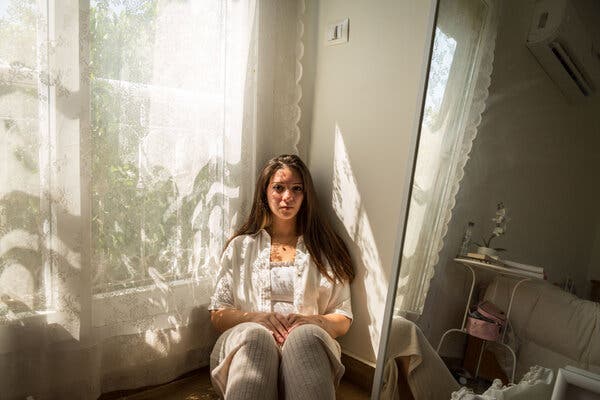
The 22-Year-Old Force Behind Egypt’s Growing #MeToo Movement
By Declan Walsh, NYTimes
In a moment of rage, Nadeen Ashraf created an Instagram page naming a man accused of being a sexual harasser. Within a week, it had 70,000 followers.
CAIRO — Nadeen Ashraf had a burning secret. Earlier this summer, an anonymous Instagram page that named and shamed a man accused of being a notorious sexual harasser at Egypt’s most prestigious university was causing a sensation among her friends. Unknown to them, she was running it.
Nadeen Ashraf, founder of the @assaultpolice Instagram page, at her home in Cairo this month.Credit…Sima Diab for
The experiment started, in a flash of fury, in the dead of night. On July 1 Ms. Ashraf, a 22-year-old philosophy major, was up late to cram for an exam the next morning when she became preoccupied with the fate of a Facebook post that had mysteriously disappeared.
Days earlier, a fellow student at the American University in Cairo had posted a warning on Facebook about a man she said was a sexual predator — a brash, manipulative young man from a rich family said to be harassing and blackmailing women on campus. Now, Ms. Ashraf realized as she stared at her laptop, the post had been deleted without explanation.
Enraged, she set aside her textbooks and created an Instagram page under a pseudonym — @assaultpolice — that identified the man, Ahmed Bassam Zaki, alongside his photo and a list of accusations of misdeeds against women.
“This guy had been getting away with stuff since the 10th grade,” she said. “Every time a woman opened her mouth, someone taped it shut. I wanted to stop that.”
After creating the page, Ms. Ashraf flopped into bed at 6 a.m. and slept through her exam. But when she awoke, she found hundreds of notifications from people who applauded her post, and about 30 messages from women who confided that they, too, had been assaulted by Mr. Zaki. Some said they had been raped.
An Egyptian #MeToo moment was born.
Within a week, Mr. Zaki had been arrested, the @assaultpolice account had amassed 70,000 followers and the page had prompted an outpouring of testimonies from other Egyptian women fed up with being humiliated and violated.
Sexual assault is endemic in Egypt — a United Nations study in 2013 found that 99 percent of women had experienced harassment or violence — but reporting it is notoriously difficult. Police officials are reluctant to register assault cases. Powerful institutions prefer to sweep accusations under the carpet. Even the families of victims, wary of scandal or feeling a misplaced sense of shame, tend to hush it up.
Ms. Ashraf’s bold page offered a new way.
“It was so wonderful,” she recalled, sitting in her family home. “A lot of the girls who got in touch said ‘I can’t believe I’m finally being heard.’ Even though it was a dark time, here they were speaking out. There was a sense of empowerment, of relief.”
On Sept. 1, the authorities charged Mr. Zaki, 21, with three counts of sexual assault against underage women, as well as multiple counts of blackmail and harassment. He remains in detention, awaiting trial.
But then a second high-profile case came to light, also through Ms. Ashraf’s Instagram page, that complicated matters. It promised to be even more sensational — an account of a gang rape by five young men in a five-star hotel overlooking the Nile. In recent weeks, however, the case has become clouded in a murk of counter-accusations and leaked images that threatens to overshadow the progress Ms. Ashraf has made — and possibly even reverse it.
“It’s very worrisome,” she said.
Ms. Ashraf, 22, is not an archetypal Egyptian rebel. She comes from an apolitical family that lives in a gated community in eastern Cairo — a place of manicured lawns and hushed streets lined with luxury vehicles where support for Egypt’s authoritarian leader, President Abdel Fattah el-Sisi, runs relatively high.
Her father owns a software company, her mother is a nutritionist, and her family stayed in the suburbs during the 2011 uprising that toppled Egypt’s longtime ruler, Hosni Mubarak, and the 2013 protests that ushered in a military takeover and Mr. el-Sisi’s rule.
When the #MeToo movement erupted in the United States in 2017, driven by accusations against the disgraced film producer Harvey Weinstein, she didn’t pay much attention — even if she did have her own experience of assault.
When she was 11 years old, a delivery man carrying laundry approached her as she walked down the street and slapped her bottom. “I had no idea why he was doing this,” she said. “It took me years to realize it was sexual.”
Public outrage over sexual assault has been growing in Egypt for about a decade, driven by high-profile attacks and, last year, harassment accusations against a famous soccer player. Even so, men continue to assault with impunity.
Working-class women run a gantlet of harassment in crowded public buses, Ms. Ashraf said. Among the rich, although dating is tolerated, young men exploit their family connections to misbehave with license, she said, and many parents reflexively blame their daughters when things go wrong.
how she could handle the country when she couldn’t even “control” the free discourse in her home environment.
Some years ago, similar misogynist comments were made by PPP MNA Khursheed Shah on the floor of the house, who informed the then speaker of the National Assembly that women should not be interrupted while speaking as they would fall ill. We see this in our daily public discourses as well: women are painted to be emotional, hysterical and incapable of rational thought and debate. That is why when women argue (online or in public spaces) on issues of public importance, it is not labeled as “debate” but a “cat-fight”. This is inherently linked to the idea that women ought to be domesticated.
Relying on Puri’s work, Sev’er writes: “the three statuses open for women are: that of some man’s virgin daughter; another man’s pious wife; and the self-sacrificing mother of sons”. And so Pakistani women continue to identify themselves as wives, mothers, sisters and daughters, rather than equal citizens and equal human beings.
As rightly pointed out by both Puri and Sev’er, “women learn that any deviation from rules can trigger violence against them”. The unfortunate reality is that when women deviate from these patriarchal rules, the all-powerful male club bands together to utilize religion, morality and deflection to restore that patriarchal control. https://www.thenews.com.pk/print/723153-doctrine-of-control-part-i