
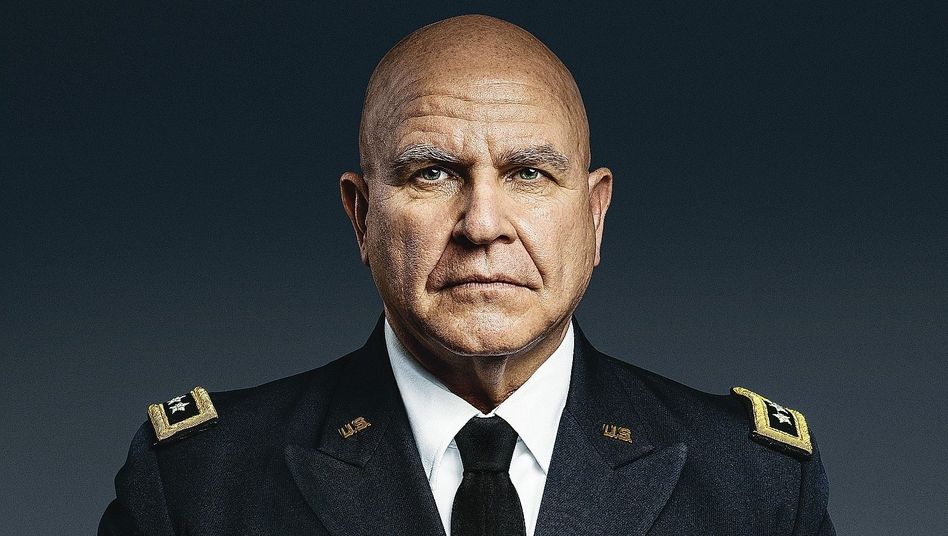
McMaster, former US National Security Advisor discusses Putin’s unscrupulous behavior, trench warfare in the White House.
DER SPIEGEL: Who is the greatest threat to the free world at the moment? Russia, China — or Donald Trump?
McMaster: It is certainly the revisionist authoritarian regimes of Russia and China. But maybe even a bigger threat may be the loss of confidence in democratic institutions and processes. This problem existed before Trump. He reflects more than amplifies divisions in our society. Our loss of confidence is due in part to unchecked globalization that left many American workers without jobs. Many felt abandoned by the political establishment. Then came the financial crisis that made a bad situation worse. The financial crisis also encouraged China to take advantage of the perceived weakness of our free market economic system and act even more aggressively on the world stage.
DER SPIEGEL: Many of the U.S.’ partners view the man in the White House and not China and Russia as the main threat. According to a poll published just a few months ago, Germans trust Vladimir Putin and Chinese ruler Xi Xinping significantly more than they do Trump. How do you explain this rather sobering finding?
McMaster: I think it expresses a remarkable level of self-loathing and moral equivalency that is the bane of the West these days. We all live in democratic countries. We enjoy the rule of law, a free press and a market economy that rewards initiative — and at the same time, we fail to recognize how much autocratic countries stifle human freedom.
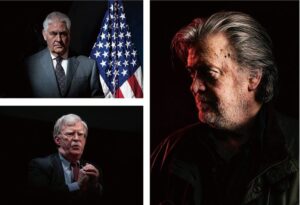
Former Trump administration officials Rex Tillerson, John Bolton and Steve Bannon: “The only man elected in the White House is the president.”
DER SPIEGEL: You had no illusions about the president’s character when you took up your post in the White House. Why did you choose to serve this man anyway?
McMaster: I saw it as my duty to serve any elected president. Since joining the military, my role model has been General George Marshall. He was the architect of the American victory in World War II and then planned the reconstruction of Europe. Marshall never took part in an election in his life. I did the same thing. I am not a supporter of a party; I do not want to be drawn into political trench warfare. But in Iraq and Afghanistan, as a soldier, I had to implement strategies that made little sense to me. They were based on some fantasy in Washington, but not the reality of the war on the ground. So, I wanted to take the opportunity to correct the strategic deficits that we have already talked about. I wanted the president to be able to base his decisions on the best possible analysis and expertise. But of course, I also had an inkling that it would be challenging to serve in the toxic partisan environment.
DER SPIEGEL: Did you know that your term in your position was coming to an end when the right-wing website Breitbart started a campaign against you and the hashtag #fireMcMaster began circulating online?
McMaster: It was meant to make my job impossible. Behind this are people who weren’t interested in serving the president, but had their own agenda. I chose to ignore it and focus on my job.
DER SPIEGEL: You’re talking about Steve Bannon, who was then Trump’s chief strategist, right?
McMaster: It was a number of people who saw the effectiveness of our process as an impediment to their narrow agenda.
DER SPIEGEL: Bannon and others wanted the president to follow an isolationist course. You successor was John Bolton, the fiercest hawk in the Republican foreign policy camp.
McMaster: There may be an element of poetic justice in that contradiction.
DER SPIEGEL: In your book, you primarily describe Russia as a threat to the free world. What is dangerous about Putin?
McMaster: Putin doesn’t feel bound by our moral standards. For example, there is irrefutable evidence that the Russians shot down a passenger plane over Ukraine in 2014. Putin tried to kill former Russian intelligence officer Sergei Skripal with a nerve agent, endangering the lives of thousands of British citizens. Most recently, he tried to poison the regime critic Alexei Navalny. Putin denies all of this. He believes the West is weak and he can get away with murder, sometimes literally.
DER SPIEGEL: Many Germans remember another Putin who gave a speech in fluent German in the German federal parliament at the end of September 2001 — a few days after the attack on the World Trade Center — and who campaigned for peaceful coexistence between the U.S., Russia and Europe. Was it a mistake to turn down Putin’s outstretched hand?
McMaster: In the 1990s, the U.S. and the Europeans paid billions to Russia to help the country transform itself into a market economy. That failed because a criminal patronage network spread across Russia, which first brought down Boris Yeltsin and then promoted Putin’s rise. In a speech in 2000, Putin himself declared that he wanted to restore his country to its old national greatness. We should not make the mistake of holding ourselves responsible for the most egregious acts of our enemies. This is what I call strategic narcissism in my book.
“I think the likelihood of (us leaving NATO) is very slim. We are not a monarchy. In such a decision, Congress would also have a say.”
DER SPIEGEL: Many Russians say that after the end of the Cold War, the West paid too little attention to the country’s strategic sensitivities. George W. Bush wanted Georgia to join NATO in 2008. Barack Obama called Russia a “regional power.”
McMaster: (laughs bitterly) Ok, all right. We offended Putin, and that is why he is now allowed to run a campaign to undermine our democracies? I suppose it also explains why Putin is allowed to oppress his own people and bend the Russian constitution so he can remain czar until 2036? That really makes no sense to me. As for the enlargement of NATO and the EU, should we really have said “no” to nations that have regained their freedom: “We are very sorry, but you are not allowed to join the EU because Russia does not want you to”?
DER SPIEGEL: No. But the U.S. didn’t care about Cuba’s sovereignty both when it supported the attempted coup in the Bay of Pigs in 1961 and imposed a sea blockade on the island during the Cuban missile crisis in 1962.
McMaster: The sovereignty of a country that doesn’t give a damn about human rights? I’m sorry, but I just don’t by that moral equivalency.
DER SPIEGEL: There is a consensus across party lines in Washington that the German government should stop the Nord Stream 2 gas pipeline project with Russia. Do you agree?
McMaster: Of course. Why do our German allies want to give Putin, of all people, influence over their economy and energy supply? Nord Stream 2 is based on a corrupt deal made by a former German chancellor who sits on the board of directors of a Russian state-owned company. The U.S. helped build a postwar order that has given Europe, and especially Germany, enormous advantages. It is sad for me to see that our German friends have not done more to counter the Russian czar who is aggressively undermining our democracies and our alliance.
DER SPIEGEL: Trump’s challenger Joe Biden is promising to regain the trust of the country’s partners if he wins the election. Is that even possible? With Richard Grenell, the Germans experienced a U.S. ambassador, who helped ensure that almost 12,000 American soldiers are withdrawn from Germany.
McMaster: The troop withdrawal is a mistake, there is no question about that. On the other hand, we have seen these fluctuations in U.S.-German relations several times. The Germans oscillate back and forth between the rejection of an American troop presence and the paranoia that we Americans are leaving them in the lurch. That was already the case during the Cold War. But know who will bring us back together? Vladimir Putin. I think he can be relied on because in the end everyone will understand how determined he is to divide us.
https://www.spiegel.de/international/world/former-national-security-adviser-h-r-mcmaster
(2)